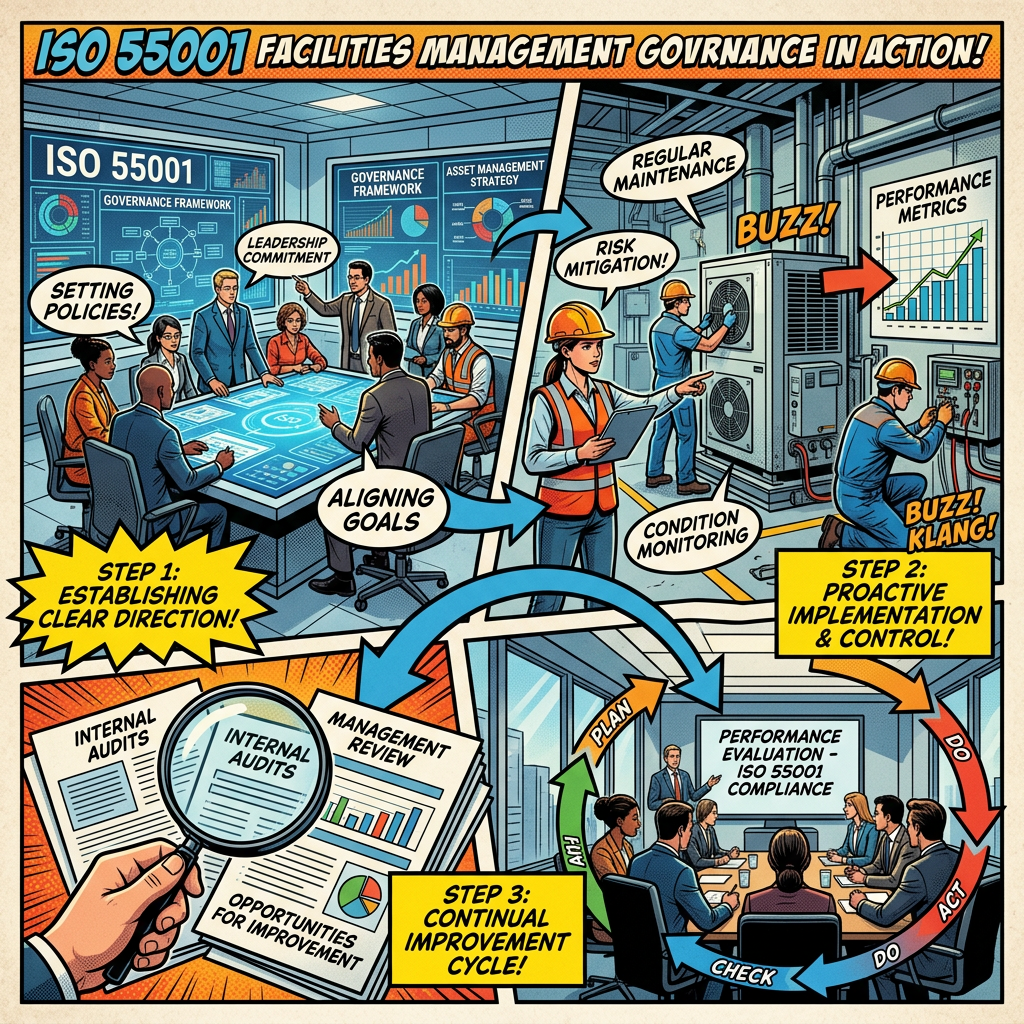
Full transparency right off the bat: I completed a CPD course on ISO 55001 recently, so I am by no means claiming to be a seasoned expert on the standard. These are just my initial impressions coming out of that session, so please don’t drag me over the coals if I’m barking up the wrong tree!
Like many people working in digital construction and information management, I am always interested in how organisation handle their assets. But stepping through the material for ISO 55001 left me feeling a bit underwhelmed.
It feels less like a practical handbook and more like another high-level road map written on the back of a napkin, pointing vaguely in the right direction without really showing you where the finish line is.
The Case for High-Level Governance
To be fair, I do understand the core purpose of a standard like ISO 55001.
In an ideal world, it exists to encourage and promote proper asset management, getting executive leadership to actually care about what happens to an asset after the construction dust settles. That top-down buy-in is vital. In day-to-day operations, facility managers are often stuck in a back office somewhere, completely isolated and lacking the leverage or resources to drive meaningful change.
You need the people at the top to say, “This matters, we are going to resource it properly, and we are going to plan for it.” Without that initial corporate mandate, nothing else moves.
Where the Standard Falls Short
Outside of securing high-level awareness, my biggest concern is that ISO 55001 reads primarily as a corporate policy exercise.
When you go into many companies, you find digital folders plastered with policy documents sitting on a hard drive or cloud server somewhere. They rarely see the light of day, except for once a year when an audit rolls around.
The standard tells you that you should be managing your assets strategically, but the guidance on how to execute that vision feels loose. It points you toward organisational intent rather than mechanical application.
The Contrast in the BIM World
In my day-to-day BIM role, the contrast is stark. Usually, project briefs arrive with a very blunt demand: “We want BIM. Give us a big model, give us everything, give us LOD 500, and give us COBie. All of it.” There is often very little real thought put into what information is actually required downstream.
Seeing an ISO 55001 framework referenced in tender bids would at least signal that an organisation is thinking about its assets strategically. But it still leaves a massive gap between the boardroom policy and the operational reality on the ground.
Why COBie Puts Meat on the Bones
When you compare high-level theory to practical execution, schemas like COBie (Construction Operations Building Information Exchange) still stand out as the gold standard for me.
- It tells you how it’s done: COBie strips away the corporate fluff. It provides an actual, battle-tested structure—rows, columns, sheets, and specific parameters—that dictates precisely what data goes where.
- It demands accountability: You can’t hide behind a vague policy document when an asset tag is missing or a data drop fails validation.
Final Takeaway
ISO 55001 is a fine starting point for raising awareness and getting executive alignment. But on its own, it feels like a road map missing half the directions.
Until standards can successfully bridge the gap between boardroom policies and the granular, data-driven execution seen in information management workflows, they risk remaining just another set of documents gathering digital dust.





Leave a Reply